

If you’ve ever wondered how Google ranks service area businesses in Google Maps, you’re not alone.
I’ve been working with more plumbers, electricians, cleaners, and other service area businesses lately, and the same confusion keeps coming up. Many feel like they should be ranking higher… but aren’t sure what’s actually holding them back.
How Google Ranks Service Area Businesses in Google Maps
Google ultimately relies on three core signals: relevance, distance, and prominence.
Imagine This…
Imagine you search “dog walker” from your living room.
Down the street, there’s a solo dog walker—knows every path, trusted by neighbours.
Two miles away, a big pet shop with a team also offers dog walking.
Who does Google show first?
It’s not the big shop. It’s the local expert, most of the time.
I put together a video to show you how this works
The Three Ranking Factors That Matter Most
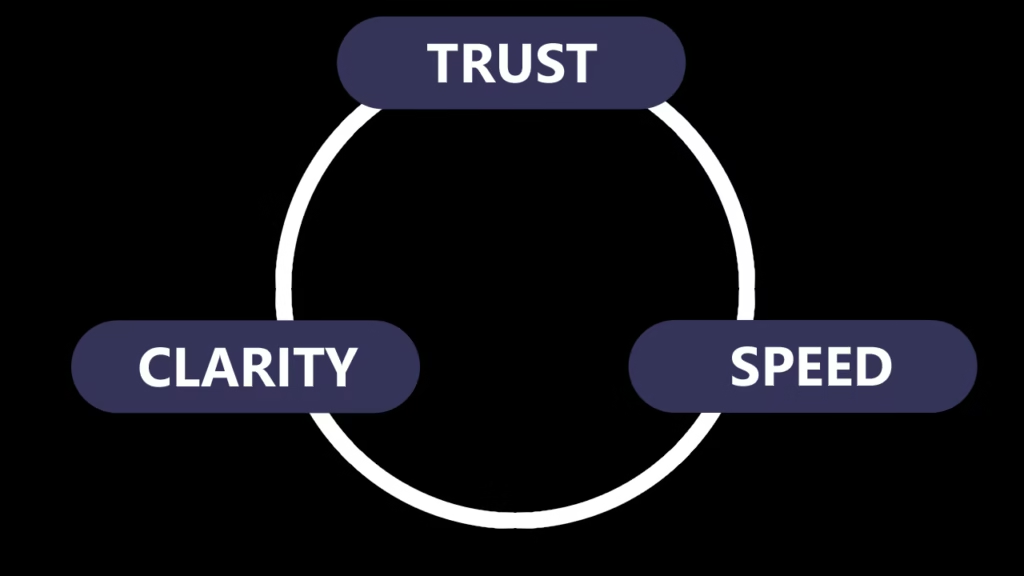
Because when Google ranks service area businesses, it primarily focuses on three things:
- Relevance – Does your business match what the searcher wants?
- Distance – How close are you to the searcher, right now?
- Prominence – How well-known and trusted are you online?
These are the foundation of how Google ranks service area businesses.
That’s it.
No requirement for a shopfront.
No bonus points for being the biggest name in town.
No penalty for being a service area business.
What Most Service Area Businesses Get Wrong
Here’s what I keep correcting in my 1-1 sessions:
Worrying that hiding their address hurts rankings (it doesn’t).
Obsessing over website size or backlinks as the main driver (it’s not).
Assuming only physical storefronts can win (completely false).
In most of my 1-1 sessions, I see service area businesses overthinking visibility issues that don’t actually impact how Google ranks service area businesses.
How Google Actually Handles Service Area Businesses
This is where things get interesting. I’ve noted a few things that reveal how it appears to work based on real-world patterns.
Google still uses your verified business address internally, even if it’s hidden. But your visibility in Maps is shaped by your service area and where the search is happening from.
In simple terms:
- Your service area defines where you’re eligible to show.
- Your location signals influence where you actually rank.
- The user’s search location heavily affects what they see.
There isn’t a disadvantage to not showing a public address, but there is a misunderstanding about how proximity and eligibility actually work.
The Big Misunderstanding
Most service area businesses think Google only uses one system.
But in reality, Google separates things like this:
- Display logic – what appears on the map and where results are centred
- Ranking logic – who actually shows up based on relevance, distance, and prominence
This is why two businesses can have identical services, but completely different visibility depending on location, trust signals, and activity.
Most service area businesses think they understand local SEO—but many are still missing simple adjustments that could improve visibility quickly.
And I keep seeing one pattern:
Your website is more important to your Google Business Profile than most people realise.
Organic SEO and Local SEO often get mixed together, but they play different roles in how Google ranks service area businesses.
Want to Improve Your Google Business Profile Rankings?
If you want to understand how Google ranks service area businesses for your specific location and niche, I’m opening a few 1-1 sessions where I break down exactly what’s holding your profile back.
Book your 1-1 session now »
Here are a few of the most common questions I get from service area businesses trying to understand how Google ranks them:
FAQ: Service Area Business Rankings
Why is my service area business not ranking on Google?
Any service can rank if it focuses on these threee areas, relevance, distance, and prominence. If your competitors are stronger in any of these areas, they may appear higher than you ,even if your service is better.
It’s rarely about having a shopfront and more about how Google evaluates your overall trust and location signals.
Does hiding my address on Google Maps affect rankings?
No, hiding your home address for your Service are Busienss does not hurt your rankings if you’re set up and registered correctly.
Google still uses your verified business address details behind the scenes to understand where and how you should appear in Google search and Maps.
Can service area businesses rank without a storefront?
Yes, absolutely.
Service area businesses can rank very strongly in Google Maps as long as they match search intent, are trusted online, and are relevant to the search location.
Many top-ranking local businesses don’t display a public address and still rank well.